
 Cart
Cart Products
ATAC-Seq Express Kit Overview

Save 20% on ATAC-Seq Spike-In Control with purchase of an ATAC-Seq Kit! Learn More
Related Products:
- ATAC-Seq Spike-In Control: Overcome variation between ATAC-Seq datasets
- High-Throughput ATAC-Seq Express Kit: Seamlessly integrating sample prep, tagmentation, amplification, and library purification for up to 96 samples in parallel
- Nextera™-Compatible CDI and UDI Primers (1-96): Multiplex more than 16 samples
- Tn5 and Pre-indexed Assembled Tn5 Transposomes: Pre-loaded ready-to-use transposomes for up to 96 ATAC-Seq reactions
- Bioinformatic Services: Custom bioinformatic analysis using data from our kits
- ATAC-Seq Services: End-to-end ATAC-Seq services for fresh and fixed samples
- ATAC-Seq Workshops: Hands-on, in‑person workshops to advance your epigenomics expertise
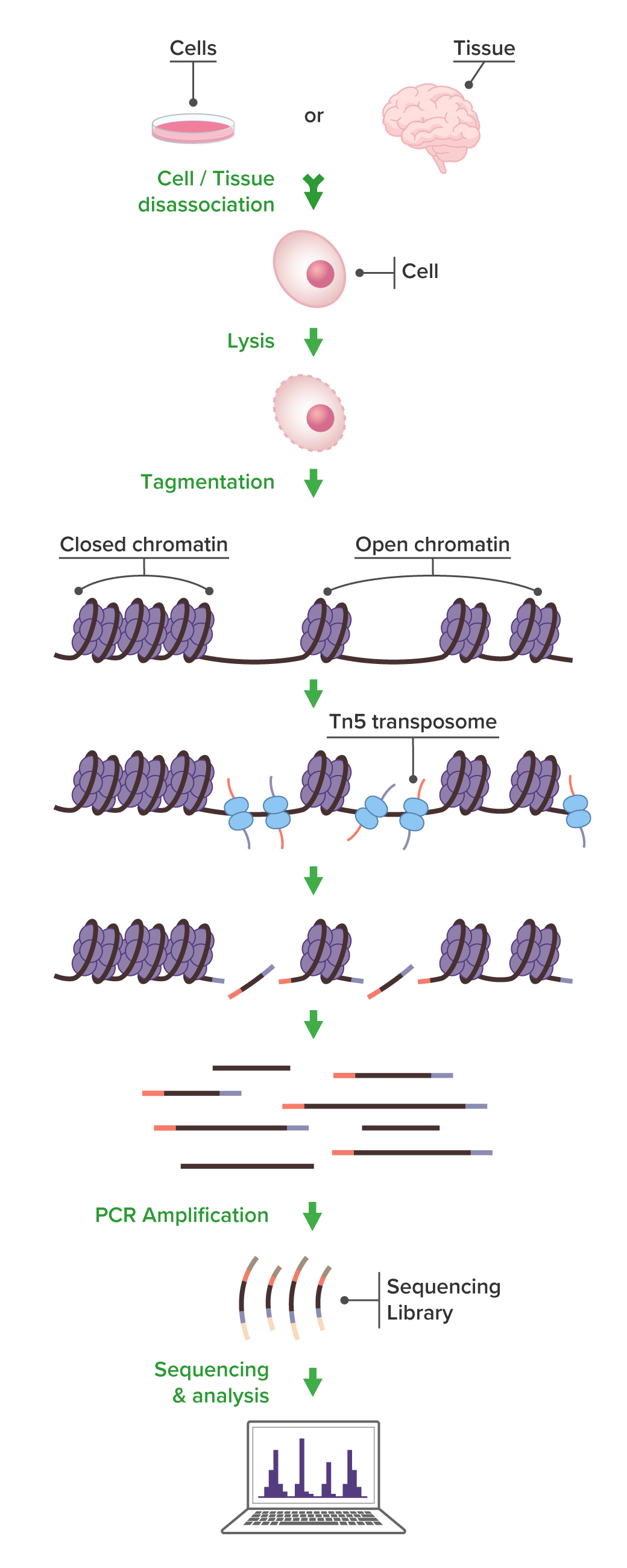
Discover the enhanced power of chromatin accessibility analysis with Active Motif’s ATAC-Seq Express Kit, now featuring bead-based cleanup for faster workflow, improved sample recovery, and better consistency. By updating the protocol with wash steps performed in 0.2 ml tubes versus the 1.5 ml microcentrifuge tubes in the original ATAC-Seq kit, the assay is much less cumbersome to perform, making it easier to process multiple samples at the same time. ATAC-Seq Express builds upon the trusted performance of our original ATAC-seq kit, making it easier than ever to generate high-quality, reproducible libraries from fresh or frozen cells or tissue.
Applications
- Genome-wide chromatin accessibility mapping
- Regulatory element discovery (enhancers, promoters)
- Epigenetic profiling of rare or precious cell types
Key Features & Benefits
- Bead-Based Cleanup for Speed & Simplicity
No more spin columns! Silica beads enable rapid cleanup steps with fewer centrifugation steps and reduced hands-on time. - High-Quality, High-Yield Libraries
Silica bead-based DNA recovery enhances sensitivity and data quality across a range of input amounts and cell types. - Faster Protocol, Same Gold-Standard Performance
Complete the ATAC-seq protocol in under 4 hours from cells to purified library-ready DNA. - Validated for a Wide Range of Inputs
From as few as 1,000 cells to 100,000 – optimized for human, mouse, and other mammalian samples. - Ideal for Downstream Sequencing
Generates high-complexity libraries ready for Illumina® sequencing with minimal background and strong signal-to-noise.
(Click image to enlarge)
How Does ATAC-Seq Express Compare with the Original ATAC-Seq Kit?
| Feature | ATAC-Seq Express Kit | ATAC-seq Kit (Original) |
|---|---|---|
| Cleanup Method | Silica Beads | Spin Columns |
| Workflow Time | < 4 hours | ~5 hours |
| DNA Recovery | Improved | Standard |
| Automation Ready | Yes | Limited |

ATAC-Seq Express Kit Contents
- ATAC Lysis Buffer, store at RT
- Assembled Transposomes, store at -20°C
- 10X PBS, store at RT
- 2X Tagmentation Buffer, store at -20°C
- 10% Tween 20, store at RT
- 1.0% Digitonin, store at -20°C
- Q5 High-Fidelity DNA Polymerase (2U/µL), store at -20°C
- 5X Q5 Buffer, store at -20°C
- 10 mM dNTPs, store at -20°C
- i7 Indexed Primer 1, store at -20°C
- i7 Indexed Primer 2, store at -20°C
- i7 Indexed Primer 3, store at -20°C
- i7 Indexed Primer 4, store at -20°C
- i5 Indexed Primer 1, store at -20°C
- i5 Indexed Primer 2, store at -20°C
- i5 Indexed Primer 3, store at -20°C
- i5 Indexed Primer 4, store at -20°C
- SPRI Beads, store at 4°C
- Silica Beads, store at 4°C
- DNA Purification Binding Buffer, store at RT
- DNA Purification Wash Buffer, store at RT
- DNA Purification Elution Buffer, store at RT
ATAC-Seq Express Kit Data

(Click image to enlarge)
Figure 1. ATAC-seq signal tracks comparing the Original ATAC-Seq Kit (Cat. No. 53150) and ATAC-Seq Express Kit methods in K562 cells.
IGV browser tracks display ATAC-seq enrichment profiles generated using the ATAC-Seq Express protocol (red) and the Original ATAC-Seq Kit protocol (green), each with 50,000 K562 cells. The tracks show highly similar chromatin accessibility patterns in fresh K562 cells. A cell titration series using the ATAC-Seq Express protocol is also shown with consistent signal across inputs of, 10,000 (blue) and 1,000 (orange) K562 cells.

(Click image to enlarge)
Figure 2. ATAC-seq signal tracks from frozen mouse spleen using the ATAC-Seq Express protocol.
IGV browser tracks display chromatin accessibility profiles from four technical replicates generated using the ATAC-Seq Express method. Libraries were prepared from 100,000 nuclei isolated and counted from 30 mg of frozen mouse spleen tissue. All replicates show consistent enrichment patterns at representative genomic loci.
(Click image to enlarge)
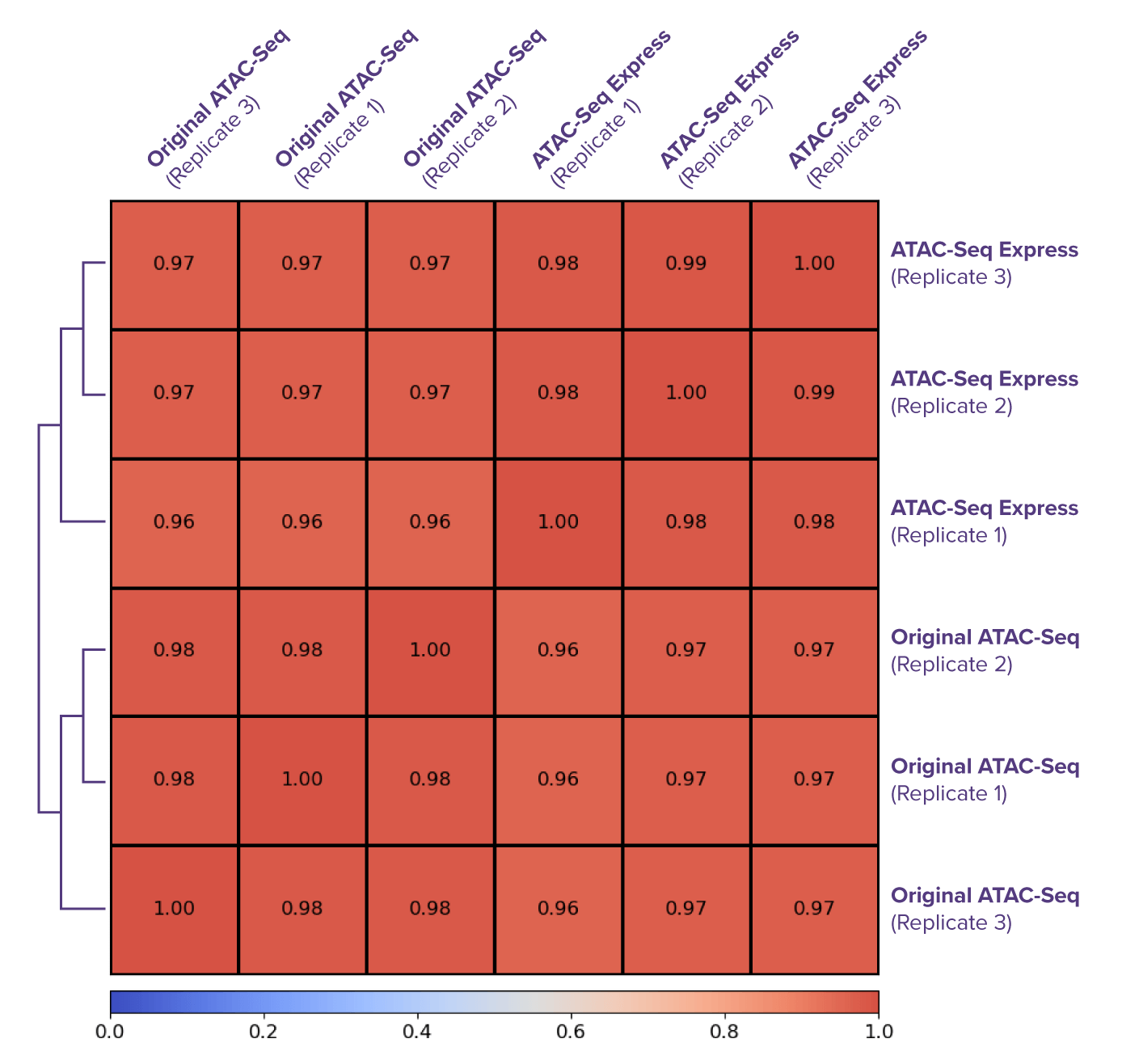
Figure 3. Correlation of chromatin accessibility profiles between the Original ATAC-Seq Kit and ATAC-Seq Express Kit protocols.
Pearson correlation heat map comparing genome-wide accessibility profiles generated using the ATAC-Seq Express Kit protocol and the original ATAC-Seq Kit method in 50,000 K562 cells. The high correlation (Pearson r > 0.96) indicates strong concordance between the two methods and shows the reproducibility of the ATAC-Seq Express Kit reagents and protocol.
ATAC-Seq Express Kit FAQs
1. Method Background & Kit Design
No, it is not identical. This kit combines the protocol from Buenrostro et al., Nature 2013 with refinements from Corces et al., Nature 2017. The buffers and workflow have been optimized in-house for higher robustness, reproducibility, and efficiency compared to the original published method.
See also: Nextera™-Compatible CDI and UDI Primers (1-96)
Learn more: [Podcast] ATAC-Seq, scATAC-Seq and Chromatin Dynamics in Single-Cells (Jason Buenrostro)
[Podcast] The Impact of Chromatin Architecture on Alzheimer's and Parkinson's Disease (Ryan Corces)
The ATAC-Seq Express Kit provides a faster and more automation-friendly workflow than the original ATAC-Seq Kit (Cat. No. 53150). It uses a 0.2 mL tube format instead of 1.5 mL tubes, enabling shorter wash steps and compatibility with multichannel pipetting or 96-well plate processing. The Express Kit also uses silica bead–based DNA purification instead of column purification, reducing hands-on time.
- Tube format: 0.2 mL (Express) vs. 1.5 mL (Original)
- Workflow speed: Faster wash steps and fewer transfers
- Purification method: Silica beads (Express) vs. spin columns (Original)
- Throughput: Multichannel pipette and automation compatible
Related product: Original ATAC-Seq Kit (Cat. No. 53150)
The recombinant Tn5 enzyme in this kit is a hyperactive Tn5 transposase produced, purified, and QC-tested in-house by Active Motif. It is supplied as pre-assembled transposomes that come pre-loaded with next-generation sequencing (NGS) adapters, making the enzyme ready-to-use with no additional assembly or optimization required.
- Expression source: Recombinant hyperactive Tn5 mutant
- Manufacturing: Cloned, expressed, and purified in-house
- QC testing: Validated for ATAC-Seq performance and activity consistency
- Format: Pre-assembled Tn5 transposomes with NGS adapters
- Ease of use: No enzyme loading or optimization steps required
Benefit: Ensures highly reproducible tagmentation and reduces experimental variability.
2. Sample Types, Input & Experimental Design
The minimum input for a single ATAC-Seq reaction is 1,000 cells or 20 mg of tissue. Using fewer cells or less tissue may result in lower library complexity and reduced signal-to-noise ratio.
- Cells: ≥1,000 viable cells per reaction
- Tissue: ≥20 mg per reaction
- Tip: Ensure cells are healthy and tissue is fresh or properly cryopreserved for optimal results
Yes, frozen cells and tissue can be used, but sample quality is critical for successful ATAC-Seq results. Cells should be cryopreserved using controlled-rate freezing with protective media to prevent ice-crystal damage. Tissue should be flash-frozen at −80°C to maintain integrity.
- Cells: Cryopreserve with protective media and controlled-rate freezing. Thaw quickly in a 37c water bath and immediately transfer to a PBS or media to dilute DMSO.
- Tissue: Flash freeze at −80°C for optimal preservation
Yes, extracted nuclei can be cryopreserved at −80°C for later use. Multiple nuclei samples can also be pooled to increase total input for a reaction, which may improve library complexity.
- Storage temperature: −80°C for long-term preservation
- Pooled nuclei: Combine multiple extractions to increase input
Yes, FACS-sorted cells can be used, but care is required because fluorescence-activated cell sorting (FACS) can damage or stress cells. High-quality ATAC-Seq libraries depend on viable cells and intact nuclei, so gentle sorting conditions and minimal handling are recommended.
- Use case: FACS-sorted cells for ATAC-Seq
- Limitation: Cells may be damaged or stressed during sorting
- Recommendation: Preserve cell viability and nuclei integrity for reproducible results
Can organoids be used in the ATAC-seq Assay?
Yes. Organoids are compatible with ATAC-seq, but must be completely removed from Matrigel or other extracellular matrices before tagmentation.
Residual ECM strongly inhibits Tn5 transposase activity and will reduce chromatin accessibility signal. Careful sample preparation is required to minimize mitochondrial DNA, background noise, and sample loss.
- Matrix removal: Fully dissolve and wash away Matrigel or ECM prior to nuclei isolation
- Dissociation: Use gentle enzymatic or mechanical methods to preserve chromatin integrity
- Nuclei quality: Optimize isolation to reduce mitochondrial DNA and debris
- Aggregation: Minor clumping is acceptable, but samples should be mostly single cells or nuclei
- Biological variability: Pool multiple organoids per replicate
- Standardization: Match passage number and differentiation stage across samples
Following these best practices ensures high-quality ATAC-seq libraries from organoid systems and improves reproducibility across experiments.
3. Tissue & Cell Preparation Workflow
Yes. We recommend the Falcon 40 µm cell strainer (Cat. No. 352340) for filtering tissue samples prior to ATAC-Seq. This strainer ensures uniform single-cell suspensions and helps prevent clogs or debris that can interfere with library preparation.
- Strainer size: 40 µm / 40 micron mesh
- Use case: Preparing single-cell suspensions from tissue
- Benefit: Improves consistency and reproducibility of ATAC-Seq libraries
No, DNase treatment is not recommended for all samples. It is useful in specific situations, such as reducing mitochondrial DNA contamination or when samples contain a high proportion of dead cells (~15%). However, DNase can also degrade nuclei from healthy cells, so it should only be applied when cells are viable and able to exclude the enzyme.
- Use cases: Mitochondrial DNA depletion, samples with >15% dead cells
- Limitation: Can remove DNA from healthy cells if not applied carefully
- Recommendation: Only apply to viable samples where nuclei integrity is preserved
4. Reagents, Handling & Equipment
Most reagents can be thawed at room temperature, except the Assembled Transposomes and Q5 DNA Polymerase. These two components are glycerol-formulated and should be kept on ice. All other reagents can be refrozen and thawed for future reactions, so it is not necessary to perform all 16 reactions simultaneously.
- Room temperature safe: All components except Assembled Transposomes and Q5 DNA Polymerase
- Keep on ice: Assembled Transposomes and Q5 DNA Polymerase (glycerol-formulated)
- Flexibility: Remaining components can be refrozen and used in later reactions
- Benefit: Supports partial runs without compromising assay quality
Yes, but using a thermomixer is recommended for optimal results. The tagmentation reaction can be performed without a thermomixer by incubating samples at 37°C in a thermal cycler with a heated lid, and successful libraries have been obtained using this method.
- Recommended: Thermomixer for consistent mixing during tagmentation
- Alternative: Thermal cycler at 37°C with heated lid
- Outcome: High-quality libraries achievable without a mixer, though slight variability may occur
Can I purchase more lysis buffer separately for optimization?
Yes. Additional ATAC-seq buffers are available for protocol optimization.
The ATAC-Seq Buffer Set (Cat. No. 53153) contains the key reagents required to fine-tune cell lysis, tagmentation efficiency, and mitochondrial read reduction.
- Included buffers: Lysis buffer, tagmentation buffer, and digitonin
- Use case: Protocol optimization and troubleshooting
- Benefit: Improves chromatin accessibility and signal-to-noise
- Compatibility: Designed for Active Motif ATAC-seq workflows
Using fresh or optimized buffer conditions can significantly improve data quality and reproducibility in ATAC-seq library preparation.
5. Library QC, Fragment Profiles & Performance Metrics
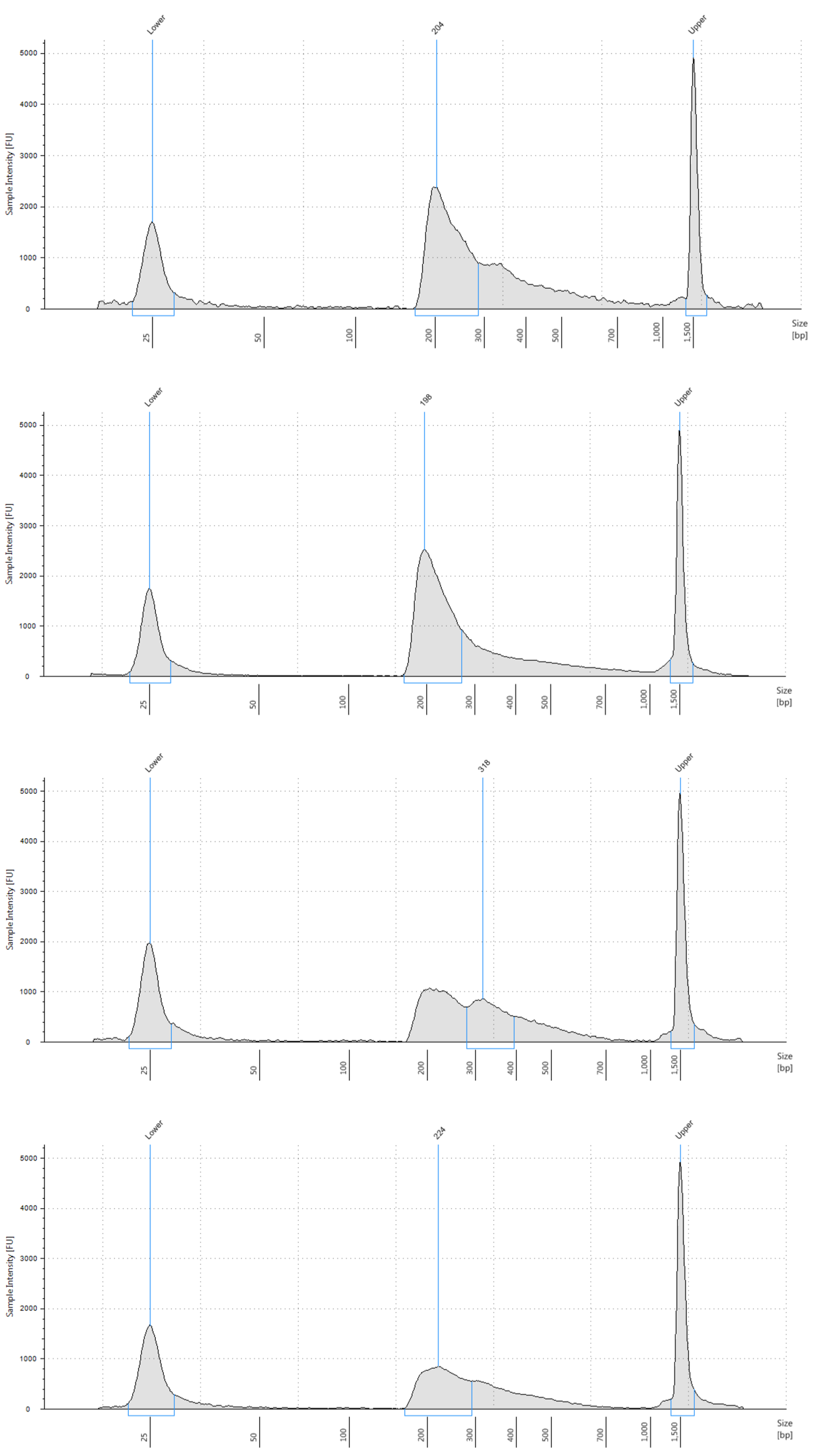
The expected ATAC-Seq library fragments range from approximately 250 bp to 1000 bp, with an oscillation period of ~150 bp corresponding to nucleosome spacing. Proper library size distribution indicates successful tagmentation and preparation.
- Fragment size range: 250–1000 base pairs
- Oscillation period: ~150 bp (reflecting nucleosome pattern)
- Quality check: Fragment analyzer or Bioanalyzer traces should show this expected distribution
- Visual reference:
![ATAC-Seq Kit Library Traces]()
(Click image to enlarge size)
Learn more about Library QC: [Blog] Library QC for ATAC-Seq and CUT&Tag
What is the expected percentage of mitochondrial reads?
Mitochondrial reads typically account for ~20% of total reads in most ATAC-seq experiments.
Elevated mitochondrial read levels consume sequencing depth and reduce usable chromatin accessibility data. Percentages above 50% usually indicate poor sample quality or compromised cell membrane integrity.
- Typical range: ~20% of total reads
- Warning threshold: >50% suggests suboptimal sample prep or damaged cells
- High-energy tissues: Liver, muscle, and many cancer cells may naturally yield 30–40%
- Permeabilization control: Digitonin in the buffers helps selectively permeabilize the plasma membrane
- Signal improvement: Reduced mitochondrial carryover increases usable nuclear reads
Maintaining low mitochondrial contamination improves library complexity, alignment rates, and downstream peak calling accuracy.
Can I increase the PCR cycle number to increase my library yield?
Increasing PCR cycle numbers does not improve ATAC-seq data quality.
While higher PCR cycles may increase apparent library yield, they also introduce amplification bias, duplicate reads,and reduced library complexity. Signal quality is primarily determined by sample integrity and efficient tagmentation.
- Data quality: Additional PCR cycles do not improve usable signal
- Risk: Over-amplification increases duplicates and bias
- Best optimization point: Tagmentation reaction conditions
- Critical factor: High-quality, intact nuclei or cells
- Recommended approach: Optimize sample prep rather than PCR amplification
For best results, focus on nuclei quality, cell permeability, and transposase reaction efficiency rather than PCR over-cycling.
6. Sequencing Strategy & Run Setup
Typically, 30 million paired-end reads per sample are sufficient, with 20 million paired-end reads being the minimum for reliable ATAC-Seq results. The exact number of reads depends on the genome size of the sample and the depth of analysis required.
- Recommended reads: 30 million paired-end reads
- Minimum reads: 20 million paired-end reads
- Considerations: Larger genomes or more complex analyses may require more sequencing depth
- Goal: Adequate coverage for reproducible chromatin accessibility profiling
Paired-end read lengths of PE38, PE42, or PE50 are recommended for ATAC-Seq. These read lengths provide an optimal balance between sequencing efficiency and data quality while minimizing unnecessary overlap or adapter read-through.
Longer read lengths (such as PE75 or PE100) may be used when higher resolution is requiredfor nucleosome positioning or transcription factor footprinting, but they are not necessary for most ATAC-Seq applications.
ATAC-Seq adapters are approximately 140 bp, and the average insert size is often ~60 bp. Using very long reads (such as PE150) increases the risk of sequencing into adapter regions, which can introduce artifacts, reduce alignment quality, and lower usable data yield.
Example Illumina run settings:
- Read 1: 38 cycles
- Index 1 (i7): 8 cycles
- Index 2 (i5): 8 cycles
- Read 2: 38 cycles
The ATAC-Seq Kit comes with 4x4 unique dual indexes for 16 samples. If you want to multiplex more than 16 samples, the Nextera™-Compatible Multiplex Primers (96 plex) kit (Cat. No. 53155) allows up to 96 reactions. These primers are provided at 25 µM and can be used directly with the ATAC-Seq Express Kit. Alternatively, other Illumina Nextera primers at the same concentration can be combined for additional multiplexing options.
- Default kit capacity: 16 unique samples (4x4 dual indexes)
- Extended multiplexing: Up to 96 samples with Nextera-Compatible Multiplex Primers kit (Cat. No. 53155)
- Primer concentration: 25 µM, ready-to-use with ATAC-Seq Kit
- Alternative: Combine other Illumina Nextera primers at 25 µM for custom multiplexing
Related product: Nextera™-Compatible Multiplex Primers
What is the recommended pooling concentration for ATAC-seq libraries?
ATAC-seq libraries should be pooled at an equimolar concentration of 0.5–4 nM prior to sequencing.
The optimal pooling concentration depends on the sequencing platform, flow cell chemistry, and loading protocol. Always follow the sequencing manufacturer’s loading recommendations for your specific system.
- Recommended range: 0.5–4 nM (equimolar)
- Normalization: Ensure all libraries are accurately quantified and normalized before pooling
- Platform sensitivity: Different Illumina platforms may require different loading concentrations
- Overloading risks: Can reduce cluster quality and increase duplicate reads
- Underloading risks: Can lower sequencing yield and data complexity
For best results, validate library concentration using qPCR or fluorometric quantification and follow the recommended loading concentrations provided by your sequencing platform manufacturer.
7. Data Analysis & Services
Can Active Motif sequence my library?
Yes. Active Motif can sequence your ATAC-seq libraries.
Our sequencing services team can provide end-to-end support, from library QC through sequencing and data delivery. Email [email protected] to be connected with the Active Motif services team and discuss your project needs.
- Service: ATAC-seq library sequencing
- Support: Library QC, sequencing, and data delivery
- Contact: [email protected]
Can Active Motif analyze my data?
Yes. Active Motif can analyze your ATAC-seq data.
Our bioinformatics and sequencing services team provides end-to-end data analysis support, from raw sequencing files to interpretable results. Email [email protected] to be connected with the Active Motif services team and discuss your analysis needs.
- Service: ATAC-seq data analysis
- Support: Primary processing, alignment, peak calling, and reporting
- Contact: [email protected]
ATAC-Seq Express Kit Documents
You might also be interested in:
| Name | Format | Cat No. | Price | |
|---|---|---|---|---|
| ATAC-Seq Express Kit | 16 rxns | 53157 | ¥19,240 | Add to Cart |
