Cart
Cart Products
Recombinant SMAD2 protein
| Aliases: SMAD family member 2, MADR2, MADH2, Mothers Against Decapentaplegic Homolog 2, HMAD-2 |
| Catalog No: 82070 | Format: 20 µg | ¥3,760 | Add to Cart |
| Catalog No: 82670 | Format: 1 mg | ¥33,200 | Add to Cart |
Request a quote for a bulk order Request Quote
Expressed In: Baculovirus Protein Species: Human
Contents
A representative Technical Data Sheet (TDS) is provided here. Please refer to the lot-specific TDS you will receive with your order for the lot-specific buffer contents and protein concentration.
Background
The transforming growth factor-beta (TGF-β) superfamily signaling controls a wide variety of biological processes from development to pathogenesis primarily through intracellular Smad proteins. Smads are structurally and functionally grouped into three subfamilies: five receptor-activated Smads (R-Smads), one common Smad and two inhibitory Smads. Of R-Smads, Smad2 and Smad3 (Smad2/3 thereafter for simplicity) transduce activin and TGF-β signals, whereas Smad1, Smad5 and Smad8 transduce signals from the BMP/GDF (Bone Morphogenetic Proteins/ Growth Differentiation Factor) family. SMAD2 is key intracellular signal transducers for TGF-β signaling and their transcriptional activities are controlled through reversible phosphorylation and nucleocytoplasmic shuttling.
Application Notes
This product was manufactured as described in Protein Details. Where possible, Active Motif has developed functional or activity assays for recombinant proteins. Additional characterization such as enzyme kinetic activity assays, inhibitor screening or other biological activity assays may not have been performed for every product. All available data for this product is shown.
Protein Details
Recombinant SMAD2 protein was expressed in a baculovirus expression system as the full length protein (accession number NP_005892.1) with an N-terminal FLAG tag. The molecular weight of SMAD1 is 53.58 kDa.
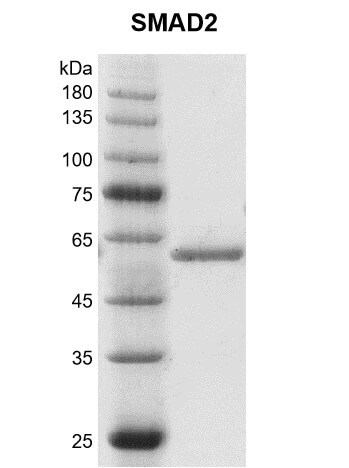
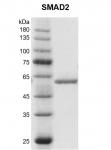
Recombinant SMAD2 protein
10% SDS-PAGE Comassie staining
MW: 53.58 kDa
Purity: >95%
Storage
Recombinant proteins in solution are temperature sensitive and must be stored at -80°C to prevent degradation. Avoid repeated freeze/thaw cycles and keep on ice when not in storage.
Guarantee
This product is for research use only and is not for use in diagnostic procedures. This product is guaranteed for 6 months from date of arrival.