Cart
Cart Products
Recombinant PI3Kα / p85 protein complex
| Aliases: Phosphoinositide 3-kinase, PI3K, P110-Alpha, CLAPO, CLOVE, CCM4, MCAP, MCM |
| Catalog No: 82042 | Format: 20 µg | ¥3,840 | Add to Cart |
| Catalog No: 82642 | Format: 1 mg | ¥33,200 | Add to Cart |
Request a quote for a bulk order Request Quote
Expressed In: Baculovirus Protein Species: Human
Contents
A representative Technical Data Sheet (TDS) is provided here. Please refer to the lot-specific TDS you will receive with your order for the lot-specific buffer contents and protein concentration.
Background
Phosphoinositide 3-kinase (PI3K) family of lipid kinases are divided into three major classes based on primary sequence, substrate preference, and regulation. While class IA PI3Ks are heterodimeric enzymes composed of a catalytic subunit (p110a, p110b, or p110d) complexed with one of five regulatory subunits (p85a, p55a, p50a, p85b, or p55g), the classIB enzyme is a dimer made of p110g catalytic subunit and p101or p84 regulatory subunit. The class I catalytic subunit polypeptides p110a, p110b, p110d, and p110g are encoded by PIK3CA, PIK3CB, PIK3CD, and PIK3CG, respectively. The regulatory subunits are encoded by five genes: PIK3R1 codes p85a, p55a, and p50a; PIK3R2 codes p85b; PIK3R3 codes p55g; PIK3R5 codes p101; and PIK3R6 codes p84.
PI3K is a lipid and protein kinase that can be activated by receptor tyrosine kinases, cytokine receptors, chemokine G protein–coupled receptors, or oncogenes, including RAS. PI3K converts phosphatidylinositol 4,5-bisphosphate (PIP2) to phosphatidylinositol-3,4,5-triphosphate (PIP3), which leads to activation of pyruvate dehydrogenase kinase 1 (PDK1) and the serine/threonine kinase AKT (PKB) (7). AKT has many downstream effectors, which regulate the cell cycle, apoptosis, protein translation, autophagy, and metabolism. Most cytokines and RTK ligands signal through class IA PI3K.
Application Notes
This product was manufactured as described in Protein Details. Where possible, Active Motif has developed functional or activity assays for recombinant proteins. Additional characterization such as enzyme kinetic activity assays, inhibitor screening or other biological activity assays may not have been performed for every product. All available data for this product is shown.
Protein Details
Recombinant PI3Ka / p85 Complex that includes full length human PI3Ka protein (accession number NP_006209.2) with an N-terminal FLAG tag and full length human p85 protein (accession number NP_852664.1) without tag was expressed in Hi5 cells. The molecular weights of PI3Ka and p85 are 125.6 kDa and 83.6 kDa, respectively.
References
Human
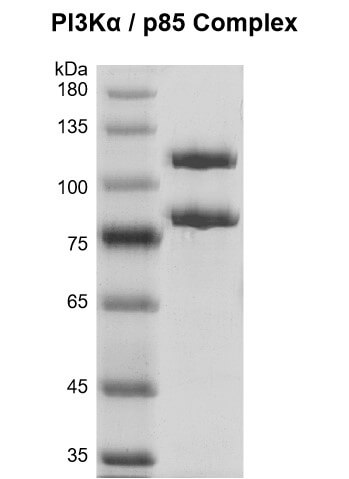
Recombinant PI3Kα / p85 protein
10% SDS-PAGE Coomassie staining
MW: PI3Kα: 125.6 kDa, p85: 83.6 kDa
Purity: ≥ 90%
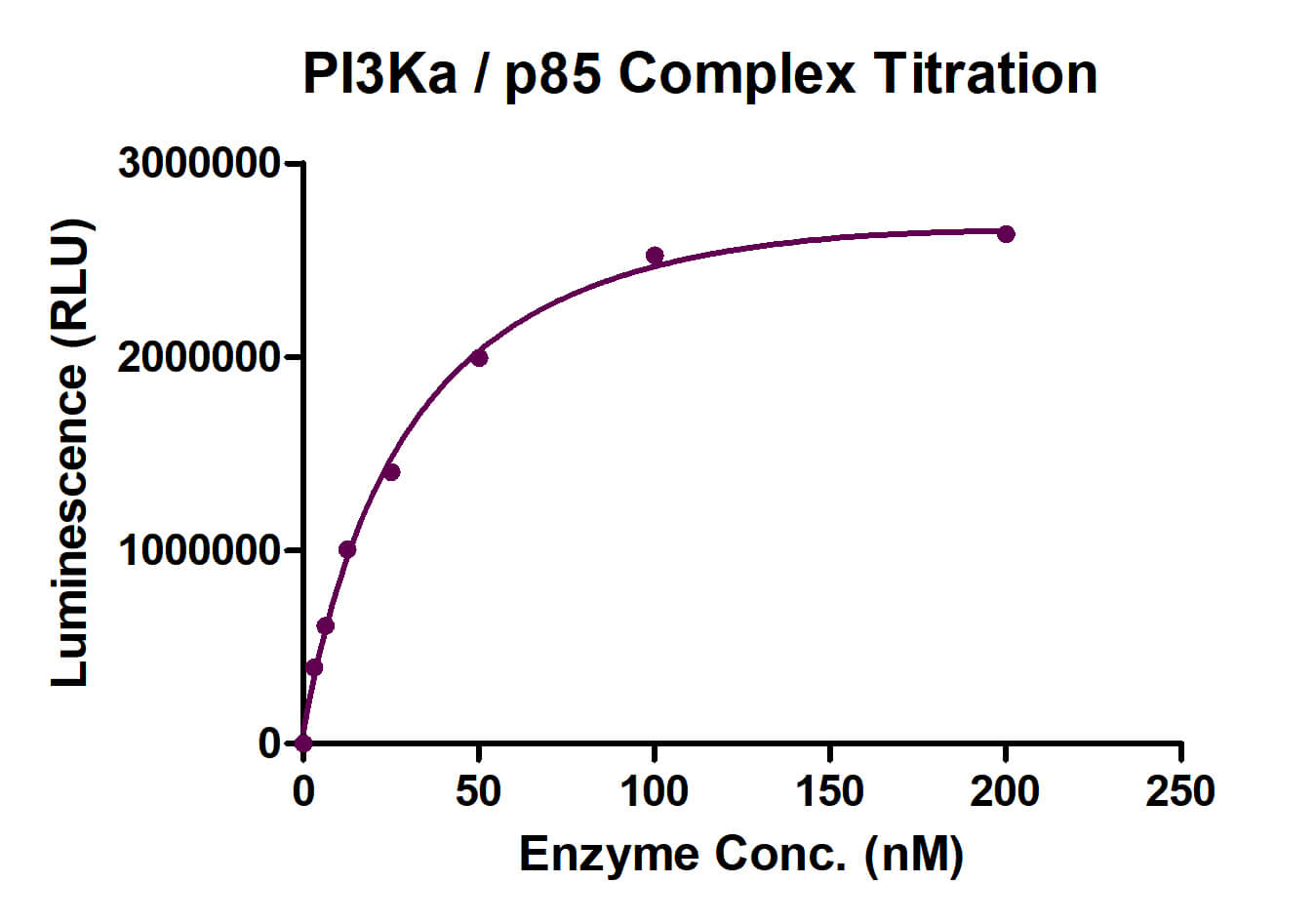
ADP-Glo assay for PI3Ka / p85 Complex activity
0.125 µg/µl PI-3 Kinase Lipid Substrate was incubated with different concentrations of PI3Ka / p85 Complex protein in a 10 µl reaction system containing 40 mM Tris-HCl pH 7.4, 20 mM MgCl2, 50 µM DTT, 0.1 mg/ml BSA and 100 µM ATP for 1 hour, then add 10 µl ADP-Glo Reagent at RT for 60min.Then add 20 µl Kinase Detection Reagent incubates at RT for 60min. All the operations and reactions were performed at RT. Finally, Luminescence measurement is collected by BMG.
Storage
Recombinant proteins in solution are temperature sensitive and must be stored at -80°C to prevent degradation. Avoid repeated freeze/thaw cycles and keep on ice when not in storage.
Guarantee
This product is guaranteed for 6 months from date of receipt.
This product is for research use only and is not for use in diagnostic procedures.